Framework Thinking - Neetcode 150 - Permutations
Here is solutions for Permutations.
1. Understand the problem
-
Given an array nums of distinct integers, return all possible permutations. You can return the answer in any order.
-
A permutation is a reordering of all elements. For n elements → total permutations = n!
2. Clarify constraints, asks 4 - 5 questions including edge cases.
- Are all numbers distinct?
- Standard version: ✅ Yes
- Maximum size of nums?
-
Usually 1 ≤ n ≤ 6 or n ≤ 10
-
Important because n! grows very fast.
- Output order matters?
- No, any order is accepted.
- Should we return a list or print?
- Return a list of lists.
- Edge cases?
-
nums = [] → usually return [[]]
-
nums = [1] → [[1]]
3. Explore examples.
- Example 1
Input: [1,2,3]
Output:
[
 [1,2,3],
 [1,3,2],
 [2,1,3],
 [2,3,1],
 [3,1,2],
 [3,2,1]
]
- Example 2
Input: [0,1]
Output: [[0,1], [1,0]]
- Example 3
Input: [1]
Output: [[1]]
4. Brainstorm 2 - 3 solutions, naive solution first and optimize later. Explain the key idea of each solution.
4.1. Solution 1 — Naive Backtracking with Used Array - Time O(N * N!), Space O(N)
-
Idea: Build an array and swap in another position.
-
Build permutations one number at a time.
-
Use a used[] array to avoid reusing elements.
-
Try every unused number at each position.
-
-
Time: O(N * N!)
-
Space: O(N) recursion + result storage
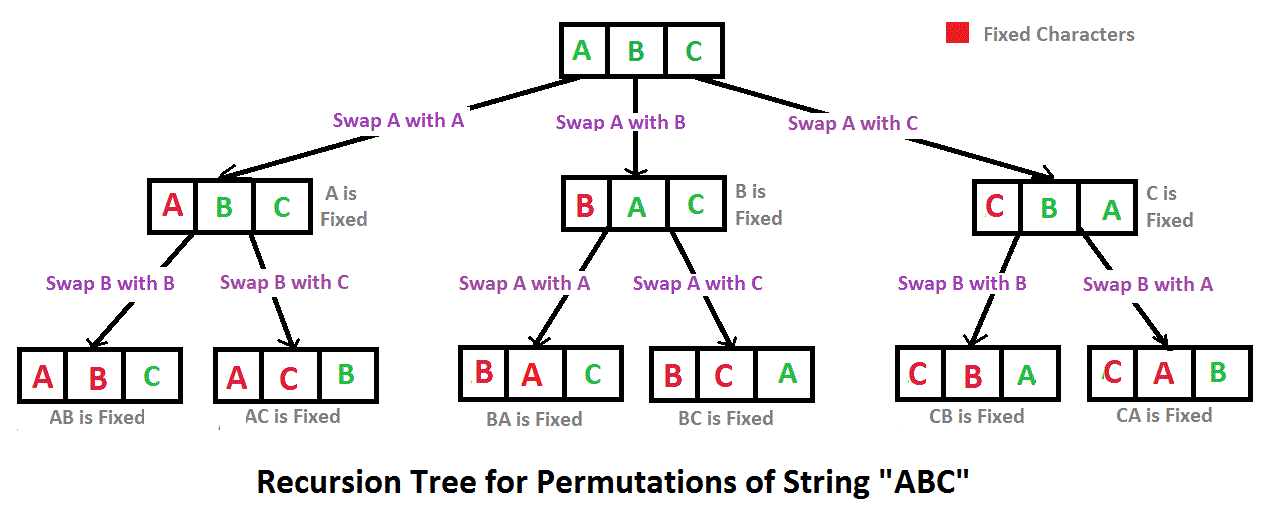
4.2. In-Place Swapping (Optimized Space)
-
Idea:
-
Fix one index at a time.
-
Swap current index with every possible index.
-
Generate permutations without extra space for used[].
-
-
Time: O(N * N!).
-
Space: O(1)
5. Implement solutions.
5.1. Recursion - Time O(N * N!), Space O(N * N!)
- Idea:
perms = self.permute(nums[1:])
=> Give me all permutations of the array without the first element.
- Then:
for p in perms:
    for i in range(len(p) + 1):
        insert nums[0] into position i of p
class Solution:
    def permute(self, nums: List[int]) -> List[List[int]]:
        if len(nums) == 0:
            return [[]]

        perms = self.permute(nums[1:])
        res = []
        for p in perms:
            for i in range(len(p) + 1):
                p_copy = p.copy()
                p_copy.insert(i, nums[0])
                res.append(p_copy)
        return res
-
Time: O(N * N!)
-
Space: O(N * N!)
5.2. Iteration - Time O(N * N!), Space O(N * N!)
- For [], Insert 1:
perms = [[1]]
-
For [1], Insert 2:
-
Insert at pos 0 → [2,1]
-
Insert at pos 1 → [1,2]
-
-
Insert 3
-
For [2,1]:
-
[3,2,1]
-
[2,3,1]
-
[2,1,3]
-
-
For [1,2]:
-
[3,1,2]
-
[1,3,2]
-
[1,2,3]
-
-
class Solution:
    def permute(self, nums: List[int]) -> List[List[int]]:
        perms = [[]]
        for num in nums:
            new_perms = []
            for p in perms:
                for i in range(len(p) + 1):
                    p_copy = p.copy()
                    p_copy.insert(i, num)
                    new_perms.append(p_copy)
            perms = new_perms
        return perms
-
Time: O(N * N!)
-
Space: O(N * N!)
5.3. Backtracking - Idea like Bit Manipulation - Time O(N * N!), Space O(N * N!)
Idea:
perm = [1]
pick = [T, F, F]
perm = [1, 2]
pick = [T, T, F]
perm = [1, 2, 3]
pick = [T, T, T]
→ ✅ Save [1,2,3]
perm = [1,2]
pick = [T, T, F]
perm = [1,3]
pick = [T, F, T]
class Solution:
    def permute(self, nums: List[int]) -> List[List[int]]:
        self.res = []
        self.backtrack([], nums, [False] * len(nums))
        return self.res

    def backtrack(self, perm: List[int], nums: List[int], pick: List[bool]):
        if len(perm) == len(nums):
            self.res.append(perm[:])
            return
        for i in range(len(nums)):
            if not pick[i]:
                perm.append(nums[i])
                pick[i] = True
                self.backtrack(perm, nums, pick)
                perm.pop()
                pick[i] = False
-
Time: O(N * N!)
-
Space: O(N * N!)
5.4. Bit Manipulation - Time O(N * N!), Space O(N * N!)
class Solution:
    def permute(self, nums: List[int]) -> List[List[int]]:
        self.res = []
        self.backtrack([], nums, 0)
        return self.res

    def backtrack(self, perm: List[int], nums: List[int], mask: int):
        if len(perm) == len(nums):
            self.res.append(perm[:])
            return
        for i in range(len(nums)):
            if not (mask & (1 << i)):
                perm.append(nums[i])
                self.backtrack(perm, nums, mask | (1 << i))
                perm.pop()
-
Time: O(N * N!)
-
Space: O(N * N!)
5.5. In-place swapping - Time O(N * N!), Space O(N * N!)
-
Idea: Try backtrack when idx = 1
-
idx = the current position we are fixing
-
Positions 0 … idx-1 are already finalized
-
Positions idx … end are candidates to place at idx
-
-
Level 1 → Fix position 1
- Place 2 at position 1:
[1, 2, 3]- Place 3 at position 1:
[1, 3, 2]
class Solution:
    def permute(self, nums: List[int]) -> List[List[int]]:
        self.res = []
        self.backtrack(nums, 0)
        return self.res

    def backtrack(self, nums: List[int], idx: int):
        if idx == len(nums):
            self.res.append(nums[:])
            return
        for i in range(idx, len(nums)):
            nums[idx], nums[i] = nums[i], nums[idx]
            self.backtrack(nums, idx + 1)
            nums[idx], nums[i] = nums[i], nums[idx]
-
Time: O(N * N!)
-
Space: O(N * N!)
6. Dry run testcases.