
Framework Thinking - Neetcode 150 - Combination Sum 2
Here is solutions for Combination Sum 2.
1. Understand the problem
-
You are given:
-
candidates[]: can contains duplicate
-
target: integer
-
-
Return all unique combinations where sum = target, each number can only used once, and no duplicate combinations.
2. Clarify constraints, asks 4 - 5 questions including edge cases.
- Can I reuse the element ?
- Can not reuse the element.
- Can candidates contain duplicates ?
- Yes
- Can the result contain duplicate combinations ?
- No
- Does order matter ?
- No [1, 7] is same [7, 1]
- What if no combination exists ?
- Return empty list []
3. Explore examples.
Example 1:
candidates = [10,1,2,7,6,1,5]
target = 8
Output:
[1,1,6], [1,2,5], [1,7], [2,6]
4. Brainstorm 2 - 3 solutions, naive solution first and optimize later. Explain the key idea of each solution.
4.1. Naive Backtracking - Time O(2^N), Space: O(2^n)
-
Idea: Do not O(2^N * N) due to each element picked only once.
-
Using a set to store the result.
-
Time: O(2^N)
-
Space: O(2^N)
4.2. Optimized Backtracking with Prunning - Time O(2^N), Space O(2^n)
-
Idea: Sort it first, and prunning if candidates[i] == candidates[i - 1] and i > n.
-
Time: O(2^N)
-
Space: O(2^n)
5. Implement solutions.
5.1. Naive Backtracking - Time O(N * 2^N), Space O(N * 2^N)
class Solution:
    def combinationSum2(self, candidates, target):
        res = set()
        candidates.sort()

        def generate_subsets(i, cur, total):
            if total == target:
                res.add(tuple(cur))
                return
            if total > target or i == len(candidates):
                return

            cur.append(candidates[i])
            generate_subsets(i + 1, cur, total + candidates[i])
            cur.pop()

            generate_subsets(i + 1, cur, total)

        generate_subsets(0, [], 0)
        return [set(combination) for combination in res]
-
Time: O(N * 2^N).
-
Space: O(N * 2^N)
5.2. Backtracking with Prunning - Time O(N * 2^N), Space O(N)
class Solution:
    def combinationSum2(self, candidates: List[int], target: int) -> List[List[int]]:
        res = []
        candidates.sort()

        def dfs(i, cur, total):
            if total == target:
                res.append(cur.copy())
                return
            if total > target or i == len(candidates):
                return

            # Case 1: Get this value
            cur.append(candidates[i])
            dfs(i + 1, cur, total + candidates[i])
            cur.pop()

            # Case 2: Skip duplicate values
            while i + 1 < len(candidates) and candidates[i] == candidates[i+1]:
                i += 1

            dfs(i + 1, cur, total)

        dfs(0, [], 0)
        return res
- Idea:
# Skip duplicate values
while i + 1 < len(candidates) and candidates[i] == candidates[i+1]:
    i += 1
This loop ensures:
- When we skip a number, we also skip all its duplicates

- So we only skip one "group" of equal values

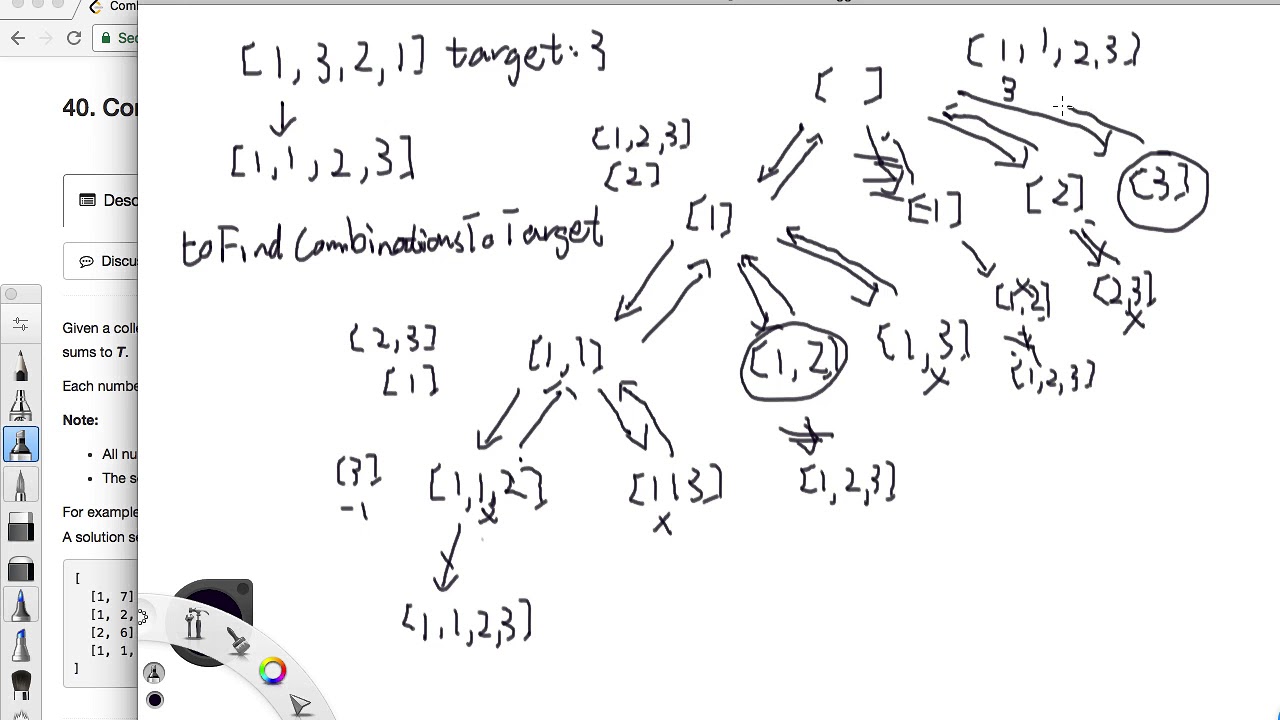
- If you have [1,1,2,2] => You still pick the duplicate 1 in the pick branch, only skip the skip branch => So you do not pick (1-a,1-b, 2,3) and (1-b, 1-a, 2, 3)
-
Time: O(N * 2^N).
-
Space: O(N)
5.3. Naive Backtracking with Hash - Time O(N * 2^N), Space O(N)
class Solution:
    def combinationSum2(self, nums, target):
        self.res = []
        self.count = defaultdict(int)
        cur = []
        A = []

        for num in nums:
            if self.count[num] == 0:
                A.append(num)
            self.count[num] += 1
        self.backtrack(A, target, cur, 0)
        return self.res

    def backtrack(self, nums, target, cur, i):
        if target == 0:
            self.res.append(cur.copy())
            return
        if target < 0 or i >= len(nums):
            return

        if self.count[nums[i]] > 0:
            cur.append(nums[i])
            self.count[nums[i]] -= 1
            self.backtrack(nums, target - nums[i], cur, i)
            self.count[nums[i]] += 1
            cur.pop()

        self.backtrack(nums, target, cur, i + 1)
-
Time: O(N * 2^N).
-
Space: O(N)
5.4. Optimize Prunning - Time O(N * 2^N), Space O(N)
Idea:
- If you have [1,1,2,2] => You still pick the duplicate 1 in the pick branch, only skip the skip branch => So you do not pick (1-a,1-b, 2,3) and (1-b, 1-a, 2, 3)
class Solution:
    def combinationSum2(self, candidates: List[int], target: int) -> List[List[int]]:
        res = []
        candidates.sort()

        def dfs(idx, path, cur):
            if cur == target:
                res.append(path.copy())
                return
            for i in range(idx, len(candidates)):
                if i > idx and candidates[i] == candidates[i - 1]:
                    continue
                if cur + candidates[i] > target:
                    break

                path.append(candidates[i])
                dfs(i + 1, path, cur + candidates[i])
                path.pop()

        dfs(0, [], 0)
        return res
-
Time: O(N * 2^N).
-
Space: O(N)
6. Dry run testcases.
December 5, 2025